


Yayoi Kusama Retrospective Comes to Amsterdam
- Fernanda Matsuoka

- 2 days ago
- 5 min read

The art world is mourning Yayoi Kusama, who passed away on August 2026 at the age of 97. Across more than 70 years she turned a private universe of dots, nets, and mirrored infinities into one of the most recognisable bodies of work in all of modern art, and she became one of the most beloved artists of her time.
Her passing arrives at a poignant moment for the Netherlands, as Amsterdam prepares to open a major retrospective of her life's work this September.
An artist who dissolved the line between self and world

Kusama was born in Matsumoto, Japan, in 1929. As a child she experienced vivid hallucinations, fields of dots and endless nets that seemed to spread across every surface she looked at, and she began to paint them as a way of making sense of what she saw.
That early vision became the language of a lifetime. In 1958 she moved to New York, where she worked across painting, sculpture, performance, film, and fashion, and held her own among the towering figures of the American avant-garde at a time when the art world offered little room to a Japanese woman finding her way alone.
Kusama was also, for many years, an overlooked pioneer. In New York she was among the first to make soft stuffed sculpture, mirrored infinity rooms, and art built on relentless repetition, ideas that better-known male peers she knew well, among them Andy Warhol, Claes Oldenburg, and Lucas Samaras, went on to explore to great acclaim. She received little of the credit at the time, and spoke openly for the rest of her life about watching her innovations absorbed by others. Part of what makes this retrospective so moving is how completely history has since caught up with her.
At the centre of her work lies an idea she called self-obliteration: the sense that the boundary of the individual can dissolve, through repetition and pattern, into something infinite and shared. It is the reason her art feels at once deeply personal and completely universal. She returned to Japan in 1973, and in 1977 she voluntarily admitted herself to a psychiatric hospital in Tokyo, where she would live for the rest of her life, working every day in a studio she set up just across the street. She never stopped, and in the new millennium her Infinity Mirror Rooms made her one of the most visited and most loved artists on earth. She turned a life of extraordinary psychological intensity into an invitation, open to anyone, to step out of themselves for a moment and feel part of the whole.
A short course in Kusama, in five works
For anyone new to her world, five bodies of work are key to know.

The Infinity Nets. Begun in the late 1950s, these are vast canvases covered edge to edge in tiny repeated loops, a single gesture multiplied thousands of times until the surface seems to breathe. They were her first mature statement, and painting without beginning or end remained close to her heart ever after.

The Accumulations. In the early 1960s she began covering everyday objects, an armchair, a boat, a pair of shoes, in dense clusters of soft, hand-sewn protrusions. Strange, humorous, and quietly unsettling, they turned the ordinary into something obsessive and alive.
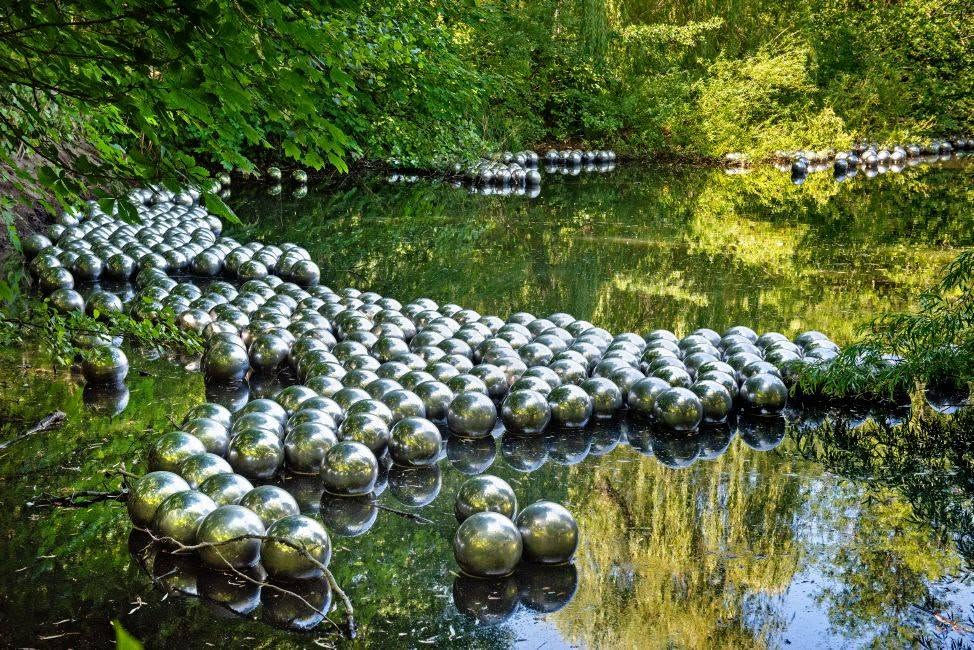
Narcissus Garden. At the 1966 Venice Biennale she filled a lawn with hundreds of mirrored silver spheres and offered them to passers-by, a mischievous comment on the art market that has since become one of her signature installations, restaged around the world.

The Pumpkins. The humble pumpkin, painted yellow and covered in black dots, became her most affectionate motif, a shape she called grounding and honest. Her monumental pumpkin sculptures are now among the most photographed artworks in the world.

The Infinity Mirror Rooms. Mirrored chambers hung with lights and dotted forms, they place the visitor inside an image of the infinite. Works such as Infinity Mirrored Room, The Souls of Millions of Light Years Away carried her vision to a global audience and, with her later collaborations with Louis Vuitton, made her polka dot one of the most recognisable marks in contemporary culture.
Why Amsterdam is a fitting place to honour her
Kusama's story has a genuine Dutch chapter. During the 1960s she spent considerable time in the Netherlands, presenting her work and forming close ties with the artists of the Dutch Nul movement, the local voice of the international Zero group, who shared her fascination with repetition, monochrome, and the space between object and viewer. Long before she was famous, the Netherlands was one of the places that took her seriously. That the fullest account of her career should now come to Amsterdam feels less like coincidence than a homecoming.
The retrospective at the Stedelijk Museum Amsterdam
From 12 September 2026 to 17 January 2027, the Stedelijk Museum Amsterdam presents a retrospective spanning more than seven decades of Kusama's work, from her earliest paintings in 1950s Japan to pieces made in her Tokyo studio in recent years. It gathers painting, sculpture, installation, drawing, fashion, collage, and records of her legendary happenings and performances, alongside a specially created new version of one of her Infinity Mirror Rooms, historic works never before shown in Europe, and new pieces made for the occasion.
Amsterdam is the final stop of a European tour that has already passed through the Fondation Beyeler in Basel and the Museum Ludwig in Cologne, which makes this the last chance to see the exhibition anywhere on the continent. Conceived with the artist and her studio during her lifetime, it now opens as a posthumous tribute, a rare opportunity to encounter the full arc of her vision in one place.
“It has been a great honour to create this exhibition in close collaboration with the artist and her studio. Kusama transformed her personal experiences into a highly distinctive visual language, which she continued to develop throughout her life without ever losing its power or conviction.” Leontine Coelewij, curator of the exhibition
Experiencing Kusama in Amsterdam with Sapiens
A retrospective of this scale is the kind of moment that rewards travelling for, and Amsterdam wears it beautifully, a city where Kusama once found an early audience and whose museums are among the finest in Europe. Book your tickets in advance!
For advisors whose clients love art, it is an ideal centrepiece for an autumn or winter journey, paired with the Van Gogh Museum and the Rijksmuseum a few steps away, unhurried lunches, and the quiet luxury of seeing a landmark exhibition without the rush. To build an Amsterdam art escape around the Kusama retrospective, contact your travel advisor to travel with us.


