top of page

THE BOOK / CITIES

CITIES

Art in the Low Countries followed the trade, and the trade kept moving. In the fifteenth century it ran through Bruges, until the channel to the sea silted up and the merchants left. In the sixteenth it moved to Antwerp, the busiest port in Europe, until war closed the Scheldt in 1585 and thousands of craftsmen, printers and painters packed up and went north. In the seventeenth it settled in Amsterdam, which had become the warehouse of the world almost overnight.
Each move left a city behind with more churches, workshops and paintings than it would ever need again. Bruges never quite recovered, which is partly why it still looks the way it does.
The chapters that follow visit the cities where this art was made. Each one connects back to the movements in the first part of the book, and points to where the works can be found today. Paintings make more sense in the places that produced them. A morning in Delft brings Vermeer closer. An afternoon in Antwerp does the same for Rubens.

​

ALL CITIES

IN BELGIUM

IN THE NETHERLANDS

IN THE NETHERLANDS

Amersfoort: the Koppelpoort, a medieval water gate with a bridge over the river.

Amersfoort

Deventer: aerial view of the old town on the IJssel river, crowned by the Lebuïnuskerk.

Deventer

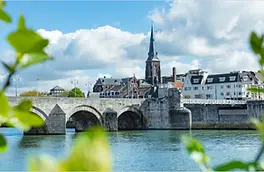
Maastricht: the stone arches of the Sint Servaasbrug over the Maas, framed by leaves.

Maastricht

The Hague: the Binnenhof lit up at dusk, with a fountain in the Hofvijver pond.

The Hague

A canal at night with illuminated tour boats and historic houses.

Amstelveen

Gouda: the Gothic City Hall on the Markt, with wheels of cheese laid out for the cheese market.

Gouda

Otterlo: the Jachthuis Sint Hubertus tower reflected in a pond among autumn trees in Hoge Veluwe National Park.

Otterlo

Utrecht: De Haar Castle rising behind its formal flower gardens.

Utrecht

Amsterdam: the Rijksmuseum's red-brick façade with its twin towers under a deep blue sky.

Amsterdam

Groningen: aerial view of the city centre with the Martinitoren and the Prinsenhof gardens.

Groningen

Rotterdam: the tilted yellow Cube Houses (Kubuswoningen) by Piet Blom.

Rotterdam

Zwolle: aerial view of the old town with the Peperbus tower and the dome of Museum de Fundatie.

Zwolle

Delft: the twin-towered Oostpoort gate and its drawbridge over the canal.

Delft

Haarlem: a canal lined with traditional gabled houses, with flowers in the foreground.

Haarlem

's-Hertogenbosch: the Gothic St. John's Cathedral.

's-Hertogenbosch

IN BELGIUM

Antwerp: the City Hall with its flags and the Brabo Fountain on the Grote Markt.

Antwerp

Jette: a red-brick neo-Gothic mansion with a turret behind green hedges.

Jette

Bruges: historic brick buildings along a canal with a passing boat.

Bruges

Ostend: the marina with yachts and the railway station reflected in the water at golden hour.

Ostend

Brussels: elevated view of a square lined with ornate townhouses at dusk.

Brussels

Ghent: the skyline of the city's three medieval towers above the Graslei on the Leie river.

Ghent

bottom of page