Thirty Years of Amsterdam Dance Event: The City That Gathers Around the Beat

Amsterdam Dance Event turns thirty this October.

From 21 to 25 October 2026, the city hosts the thirtieth edition of an event that began in 1996 as a small conference for a Dutch music industry that suspected it was onto something. Three decades later, ADE is the largest club festival in the world and the most important annual gathering of the people who make electronic music happen.
Thirty years is long enough for something to stop being an event and become a season. In Amsterdam, people now organise their October around it. Hotels, taxi drivers, record shops, coffee bars and city officials all know exactly what "ADE week" means.
There is an older pattern underneath all of this. Long before there were cities, there was a fire. People came back at the end of the day carrying what they had found. Food, yes. Also songs, news, rhythms picked up from a group met three valleys away. The gathering was the point. What was gathered got passed on, and what was passed on became culture.
Every October, Amsterdam does the same thing with a sound system.
What thirty years built

The 2025 edition drew around 600,000 visitors, close to 3,500 artists and more than 1,200 events across some 300 venues. Concert halls, warehouses, churches, museums, boats, basements, hotel lobbies. For five days the map of Amsterdam is redrawn by programming rather than by geography.
The growth is worth pausing on. In 1996 this was a few hundred professionals in a handful of rooms on the canals. What it became says something about how a culture spreads when it is allowed to travel.
The half of ADE that happens in daylight

Here is the part most visitors never see, and the part that explains everything else.
ADE has two bodies. At night it is a festival. During the day it is one of the biggest business conferences in Europe.
That daytime programme is called ADE Pro, and it brings more than 11,000 professionals to Amsterdam: label owners, booking agents, promoters, festival programmers, publishers, lawyers, streaming executives, sound engineers, technology founders, city officials. They work out of Felix Meritis on the Keizersgracht, the Andaz hotel, and Rosewood Amsterdam, which serves as the networking and matchmaking hub. Recent editions have put people from Spotify, Sony Music, Epic Games and Google DeepMind on the same stages as artists.
Why an industry does business inside a party
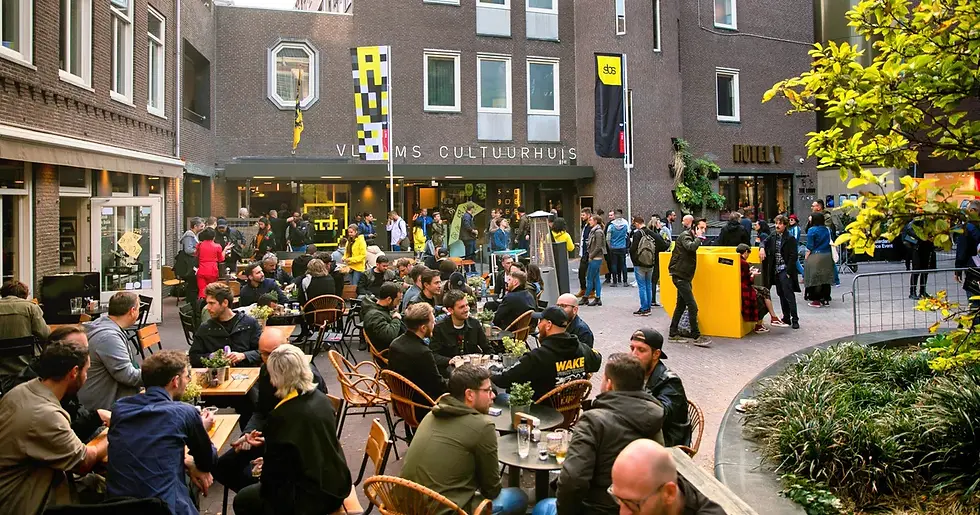
Because this one has almost no head office. Electronic music is built from thousands of small operators scattered across dozens of countries. A booking agency of four people in Berlin. A label run from a bedroom in Lagos. A festival in Chile, a distributor in Seoul, a venue in Tbilisi. They work with each other constantly and almost never in the same room. ADE gives them one week a year when the entire chain is within cycling distance.
So the deals get made in daylight and tested at night. A booker watches an artist at two in the morning in a room of two hundred people, then books them for a stage of twenty thousand the following summer. A label finds its next distributor over coffee on Tuesday. The panels, the keynotes and the "Meet The..." sessions (speed matchmaking with the people who actually sign contracts) are built for exactly this.
The programme has grown its own neighbourhoods. ADE Lab works with emerging professionals through masterclasses, mentoring and studio sessions. ADE Green looks at the environmental footprint of touring and live events. ADE Startups gathers the technology side. ADE Culture Hub sits where electronic music meets the wider arts. Access runs through a single Pro Pass valid for the whole week, which tells you how the organisers think about it: one continuous conversation rather than a series of tickets.
What a thirtieth birthday is for

Amsterdam took its nightlife seriously earlier than most places. It was among the first cities to give night culture a formal voice at city hall through a night mayor, and it has spent years making the case that clubs are cultural infrastructure in the same sense as a concert hall.
That case gets a new instrument at this anniversary edition. ADE and VibeLab launch the Nighttime Culture Index, measuring the cultural health of nightlife across six cities on six continents: Amsterdam, Lagos, New York, São Paulo, Seoul and Sydney. It looks at diversity and representation, creative ecology, space and infrastructure, community and belonging, policy, and sustainability. The interesting move is what it leaves out. Money spent is easy to count. What the index tries to count is whether a city's night still produces anything.
Thirty years is also long enough to have produced heritage of its own. A club with two decades of history. A sound engineer who trained three generations of others. A genre that grew in one neighbourhood and then travelled the world. All of it survives the way heritage always has, by being practised and passed on.
Five days in October

ADE is an unusually generous week. You can spend it entirely in music and it will be a good week. You can also read it as a live demonstration of how a modern culture sustains itself: openly, in public, in the same city where its product is being played, with the people who make it standing in the room.
Amsterdam has kept this tradition for thirty years, at a hundred and thirty beats per minute!